Power Houses: Furnishing Authority in New France,  1660-1760
  • Home
  • Blog

Telling Time at the Château

6/26/2013

3 Comments

 
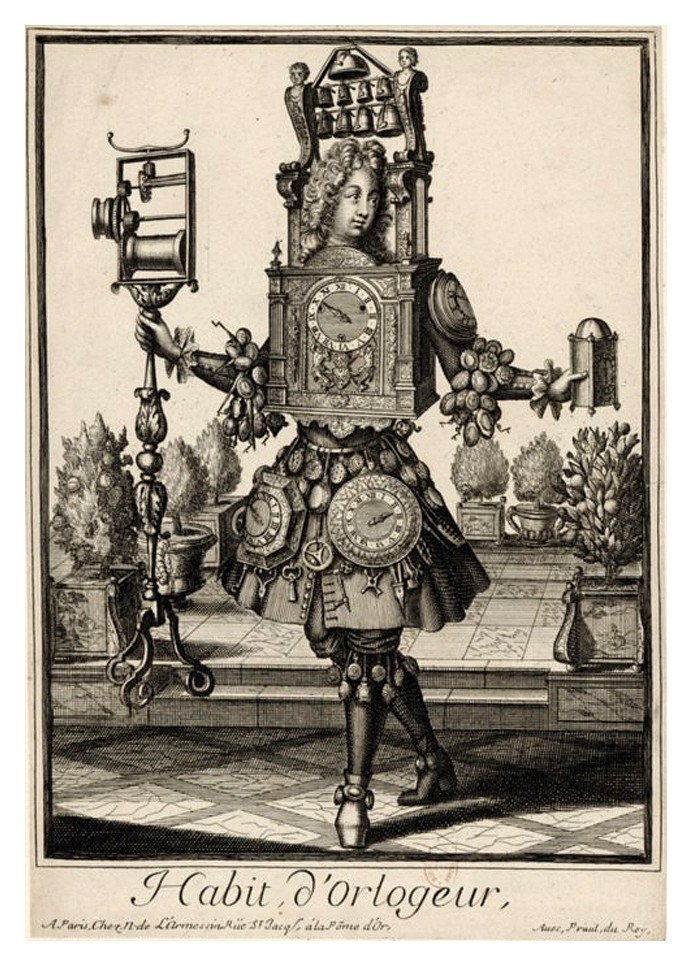
PictureHabit d'orlogeur, circa 1700
For most people in the eighteenth century, knowing the exact time was an unnecessary luxury. Farmers, craftsmen, and other working class individuals could rely on the sun to tell them that it was time to work. Sundials and hour glasses provided rudimentary tools to tell time. Clocks and watches were more often than not the purview of elites, whether bourgeois merchants or noblemen, including the governors and intendants of New France.  Both Philippe and Pierre de Rigaud owned expensive timepieces that functioned as utilitarian objects and extensions of their power and prestige.  Intendant Dupuy owned both clocks and timepieces set within complex scientific machinery. By the eighteenth century, such objects also symbolized the fashion for science and technology.

Clocks were present in French colonial Canada as early as the 1630s and were generally the property of religious communities. To the astonishment of Amerindian visitors, the Jesuit mission at St-Joseph displayed a clock by 1634. Metropolitan elites could demonstrate their piety through donations to missions and religious orders established in New France; a Monsieur de Bernières donated a clock to the Ursulines of Québec in the early 1650s. The first public clock in Canada was installed by 1710 at the Sulpician seminary in Montréal.

Colonial craftsmen in Montréal and Québec were called upon to create and repair timepieces including clocks and pocket watches by the eighteenth century, although Swedish visitor Pehr Kalm noted that they were surpassed by those working in British colonial settlements such as Philadelphia and New York when he visited New France in 1749. Henri Solo or Solon is the first horloger, or clockmaker, mentioned in colonial archives. He worked in Québec beginning in the mid-1720s and was soon joined by others.
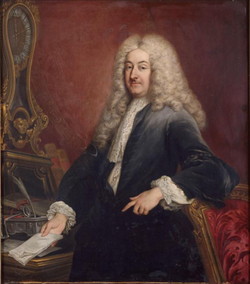
PictureUnidentified royal minister beside a clock, circa 1730
A "pendulle de marqueterie avec des ornemens de cuivre avec son pied" ("marquetery clock with copper ornaments and its stand") was among the furnishings from the intendant's palace in Québec sold at auction in 1731. Claude-Thomas Dupuy, intendant of New France, did not get along well with the governor, the marquis de Beauharnois, and was recalled in 1728 after serving for two years. His property was seized and sold in 1730 and 1731 to pay off his many debts. In addition to this clock, Dupuy owned four others as well as a number of astronomical tools, a large library, musical instruments, and sheet music for composers including Jean-Baptiste Lully and Louis-Nicolas Clérambault.

Upon his death in 1760, Henri-Marie Dubreil de Pontbriand, the last bishop of New France, owned a pendule à ressort appraised by Danré de Blanzy at 300 livres. The bishop left this clock, along with his furniture, linens, and the bulk of his remaining worldy goods, to the Sulpician order of Montréal.
Eight of the bishop's armchairs and a chest of drawers exist in the Sulpician collection today, as does the clock! Made in Paris by horloger Charles Voisin (1685-1761) circa 1740, the clock face is set within an ormolu-mounted wooden case that also bears Voisin's label. As the bishop assumed his position in Québec in 1741, the clock could have come to Canada with the bishop or been purchased via a merchant or some intermediary agent after his arrival.
Picture
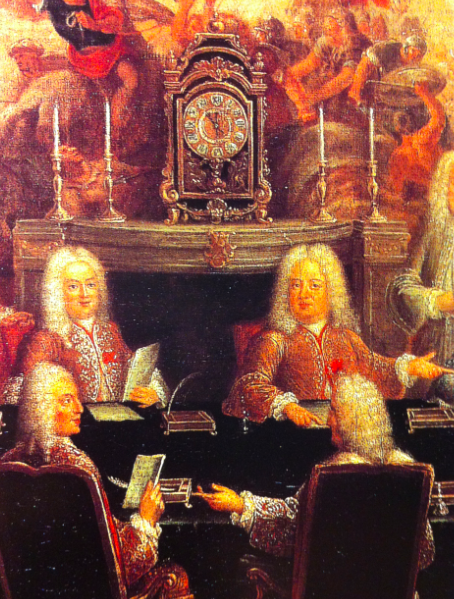
Conseil de la régence during the minority of Louis XV, circa 1720; this could easily be the colonal Conseil Supérieur at the intendant's palace in Québec
The 1726 inventory of Philippe de Rigaud's furnishings at the hôtel de Vaudreuil in Montréal records a clock valued at 200 livres by the solicitor and bourgeois merchant, René de Couagne.  The clock had been removed from the hôtel for safekeeping by François Le Verrier (then-husband of the future marquise de Vaudreuil-Cavagnial), and Couagne, accompanied by Ignace Gamelin, visited him to inspect the clock in June of 1726.
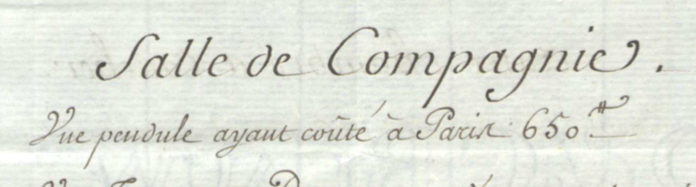
Pierre de Rigaud also owned a clock, displayed in salle de compagnie of the château Saint-Louis in the 1750s. It was among the items stolen from the vaults of the château in 1759. He claimed that it had cost 650 livres and had been purchased in Paris when seeking restitution from Great Britain for its loss in 1771. Although he mentioned undervaluing his property in order to secure a minimum amount of compensation, his explicit note of the clock's cost and origin is interesting compared to his father's clock and those in other Canadian interiors. At three times the value of Philippe's in 1726, it is possible that Pierre's clock was a more in keeping with the extravagant rococo models produced in Paris during the middle part of the reign of Louis XV.    
Picture
Pierre de Rigaud inventory, 1771

Both Philippe's 1726 probate inventory and Pierre's 1771 claim refer to timepieces as pendules, referring to their regulation by means of a pendulum. The Dictionnaire universel, first published in the 1690s, referred to pendulum clocks as a "modern invention" developed at the turn of the eighteenth century. Several craftsmen were involved in the creation of clocks and other timepieces. Actual clockmakers, or horlogers, made the clock face and inner workings. The outer cover could be the work of a cabinetmaker, or ébéniste, or a fondeur-ciseleur who worked to produce a metal mount for the clock. It is likely that Philippe bought his clock during a return trip to Paris in the mid-1710s; Pierre made a point to identify his clock's Parisian origin, and it is likely that he bought it there between 1753 and 1755 between his governorships of Louisiana and New France. Clocks could be purchased from a variety of dealers in the eighteenth-century capital.  Marchands-merciers specialized in furniture and luxury goods including porcelain, mirrors, and draperies, and it is possible that the Vaudreuil pendules were bought from such merchants.
3 Comments

Research Update

6/19/2013

0 Comments

 
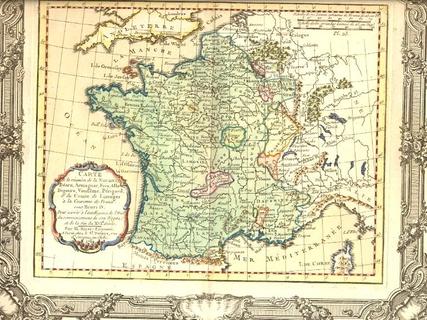
PictureHistorical map of France in 1610, published 1764
I'm currently in France, where I'll be posting periodic updates and interesting findings. I'll mostly be in and around Paris, but am planning a trip to Bordeaux in July. The internet isn't great, but I'll do my best to post! À la prochaine !

0 Comments

Meet the Tapissier

6/19/2013

0 Comments

 
PictureEncyclopédie, 1762
Pierre de Rigaud's 1771 inventory was drawn up as part of a legal claim for the restitution of property stolen from the château Saint-Louis in 1759. In addition to listing actual objects, this document provides a wealth of detail on the people who lived and worked within its walls at the end of the French regime. Several of them worked closely with keeping the château's furnishings safe and in good condition.

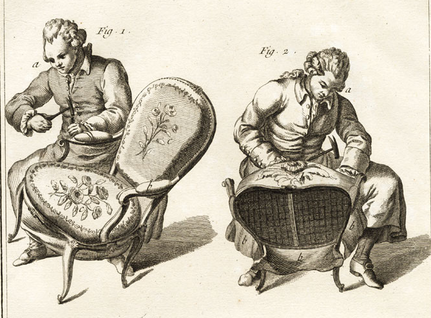
I was surprised to find that among them was a tapissier, or upholsterer. Like the other servants and staff working at the château, this craftsman is unfortunately unnamed. Presumably a man, this individual shared a room with a valet whose shared furnishings included two beds with bedhangings, a chest of drawers, six upholstered chairs, window curtains, an overmantel mirror, and andirons. It is unknown whether he trained in Canada or France. Mention of tapissiers working in French colonial Canada can be found in notarial records as early as 1667, when Jacques Leprou, an upholsterer from Rouen, was recorded as living in Québec. Pierre-Simon Chanazart, a maître tapissier born to a family of Parisian upholsterers, was employed by the governor-general, the marquis de Beauharnois, in 1728.

French craftsmen are also known to have been brought to Louisbourg, a colonial fortress on what is now Cape Breton Island in Nova Scotia and one of the largest port towns in North America before 1760. Having signed three-year contracts, these artisans were called upon to execute the interior woodwork of the château Saint-Louis of Louisbourg, home to the governor of the colony of Île-Royale.

Pierre's 1771 inventory, coupled with his father's from 1726, reveals the importance of upholstered seating furniture as well as textile wall hangings, or tentures, and draperies such as curtains and portières in elite society of both the French colonial regime in Canada and the ancien régime in France. Reflective of both symbolic etiquette and concern for fashion and style, upholstered furnishings revolutionized French interiors circa 1700 as they accommodated something that we often take for granted in our chairs and couches today: physical comfort. The château's tapissiers would have been responsible for maintaining textiles on walls and those covering beds, windows, and doors.

Both Pierre and his father Philippe owned finished pieces in addition to keeping a ready stock of upholstery textiles , furniture frames, and other supplies for the confection of new chairs and couches. A petit cabinet at the château held a cherry saufa (sopha) frame valued at 15 livres in 1726; ten armchair frames were appraised in a nearby chamber, with nine described as walnut. In 1771, Pierre remembered there being green and red velvets, toiles, Indian cottons, and other upholstery fabrics along with gilt nails, horsehair (crin), batting, and armchair (fauteuil) frames, all purchased in Paris for over 12.000 livres. At least one upholstery nail or tack has been excavated archaeologically at the site of the château by Parks Canada.

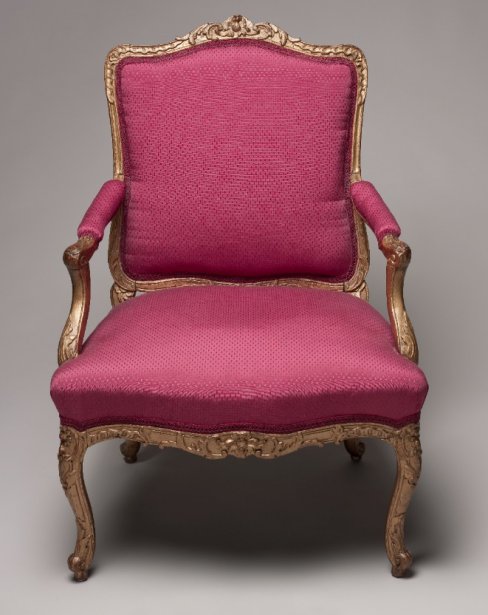
The notary appraised over 100 chairs at the château Saint-Louis following Philippe de Vaudreuil's death in 1725. These ranged from sedan chairs to upholstered fauteuils. According to Pierre de Vaudreuil, the salle de compagnie contained 16 fauteuils covered in petit point upholstery in 1759. A gilt beech armchair in the collection of the Musée de la civilisation in Québec, made in Paris by craftsman Jean Gourdin (1690-1764), is possibly one of these.  Known as a fauteuil à la reine because of its square-shaped back, the chair's pink upholstery is not original. Other furniture with a Vaudreuil provenance survives at the McCord Museum in Montréal. Possibly used to furnish the hôtel de Vaudreuil, a private home built by Philippe and later rented to the crown for use by successive royal governors, I'll be visiting the McCord collection of Vaudreuil furniture in July.

Picture
fauteuil à la reine, circa 1740-1760, Jean Gourdin, Musée de la civilisation
0 Comments

Meet Madame de Vaudreuil-Cavagnial

6/18/2013

0 Comments

 
PictureLibrary and Archives Canada
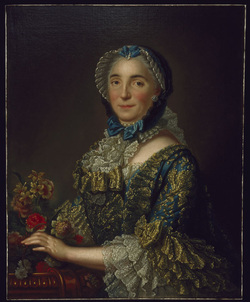
Jeanne-Charlotte de Fleury de La Gorgendière, marquise de Vaudreuil-Cavagnial
(1683-1764)


Seventeen years her husband's senior, Jeanne-Charlotte Fleury de La Gorgdendière was born to a minor noble family, the seigneurs or lords of Eschambault, in Québec in 1683. She married a military officer, François Le Verrier de Rousson, in 1705. Widowed in 1732, Jeanne-Charlotte appears to have been quite the feisty lady; without a husband's protection, she turned to retail as a means to make ends meet for herself and her two children. She married her second husband, Pierre de Rigaud, after a lengthy relationship that began sometime before 1743; the unmarried couple sailed to France after his mother's death in 1740, and she accompanied the marquis to Louisiana when he was named governor. They were finally married in New Orleans in 1746.

Although metropolitan nobles forfeited their social privileges if they engaged in any type of commerce or trade in France, the colonial nobility was freed from such constraints by a 1680s royal decree. It was believed that they would help stimulate the provincial economy. However, distance from France did not lessen ingrained cultural values, especially as they applied to nobility, women, and trade. In French colonial New Orleans, the marquise de Vaudreuil ignored these by running a retail store from the governor's home. Honoré de Villebois de La Rouvillière, intendant of Louisiana and second in command after the governor, described how the marquise practiced "a baser commerce" in a 1753 letter. She apparently had "business with everyone here and she forces the merchants and individuals to take in her merchandise to sell at the prices that she fixes. She has a storehouse at her house of all sorts of drugs, which her steward sells; and when he is not there she takes up the ell and the measuring rods herself. Her husband is not ignorant of it. He gets a good revenue from it, and this is the motive of all his desires and his occupations."

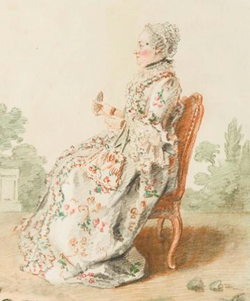
PictureThe marquise circa 1760-1764, watercolor by Carmontelle
The couple returned to France in 1753, and their surviving portraits by Donat Nonnotte date to the time of this metropolitan sojourn. They left again for North America in 1755 when the marquis was named governor-general of New France. They were back in France by 1760, and love letters between the marquise and her husband survive from the period of the latter's imprisonment in the Bastille in 1762. She herself died in Paris in 1764.

0 Comments

Fun with Photoshop

6/15/2013

0 Comments


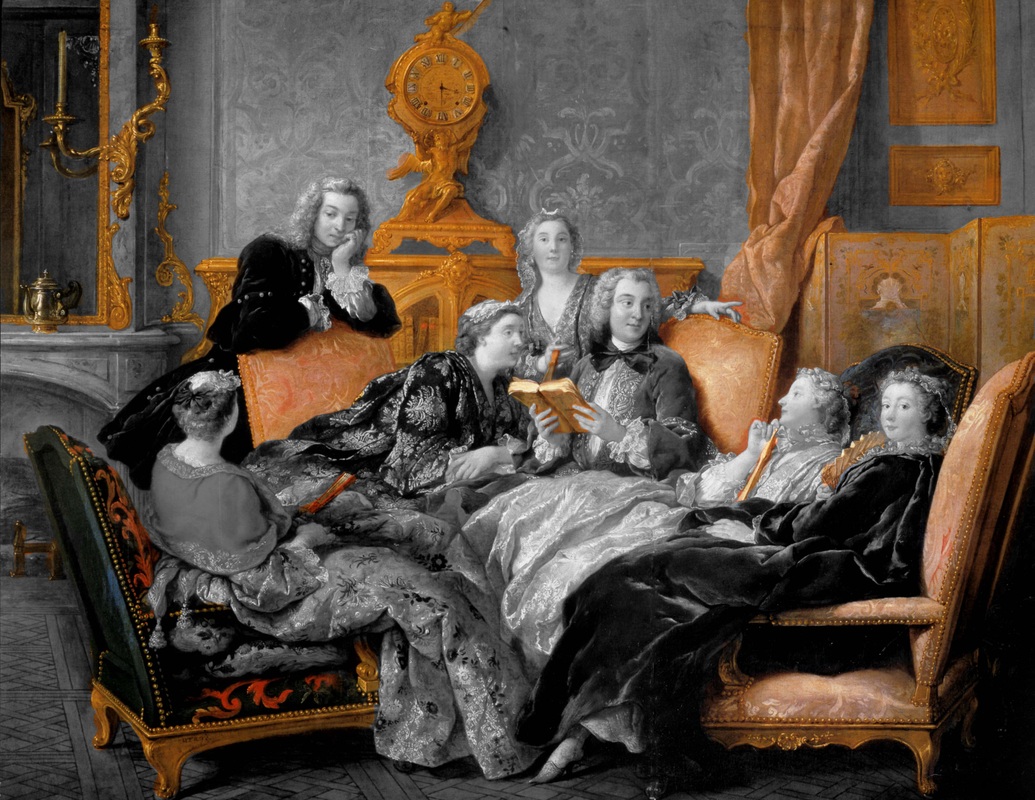
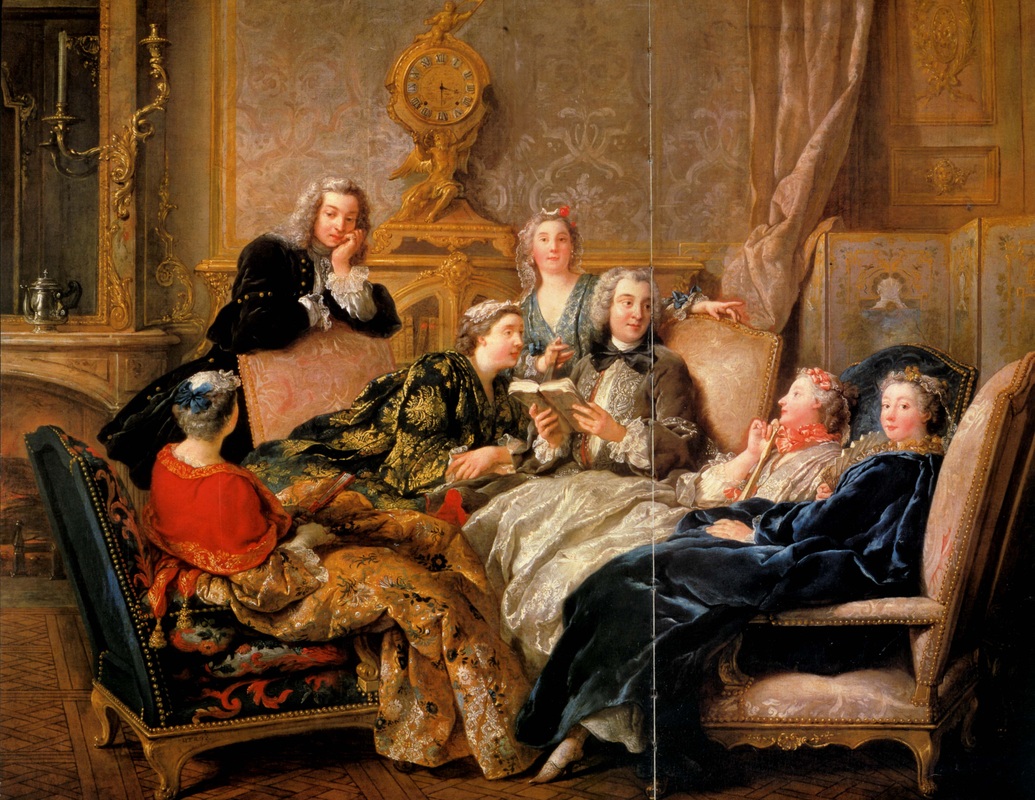
I like furniture. I like François de Troy. And I like coloring. As part of the DelPHI Summer Institute, I had the opportunity to work with Photoshop in a workshop at the University of Delaware's Student Multimedia Design Center. This experience allowed me to enjoy the above three things in a way that will be useful in presenting powerpoints and public presentations on my research.

The painting posted here, a circa 1728 work by François de Troy, is in the collection of Houghton Hall in Norfolk, England. What started as an exercise using the "history brush" function ended with me making this masterpiece as I colored in the furniture and various decorative objects. Although the figures' costumes showcase a multitude of contrasting colors, I was struck at the profusion of gold and yellow tones used to capture the furnishings and reminded of the importance of such detail. Gilt furniture mounts, clocks, hardware, and fixtures such as wall sconces could all be found in both public and private spaces of Québec's château Saint-Louis in the eighteenth century.  Like Versailles, the colonial governor's residence underscored the power and prestige of France and the absolute monarchy that colonial governors represented.  
Picture
Picture
0 Comments

Necessary Seats

6/14/2013

0 Comments

 
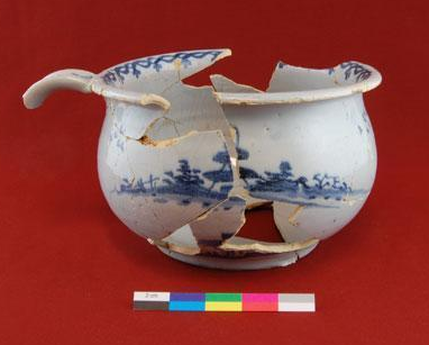
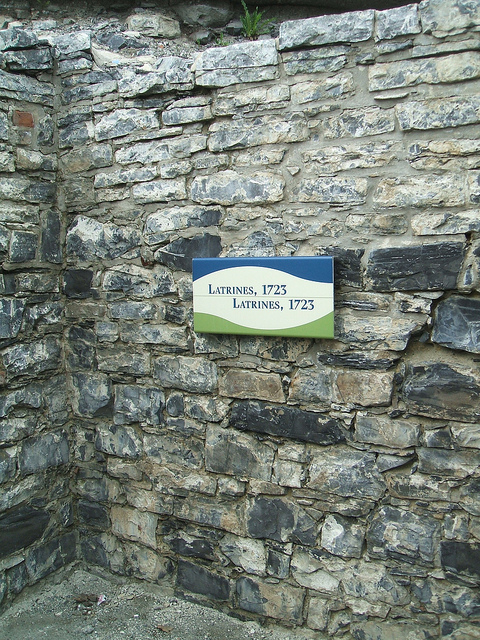
Notably missing from the 1719 floor plans of the château Saint-Louis is any sort of running water or lavatory system. Privies have been excavated on the site, and fragments of chamber pots have also been found by archaeologists. By 1724, both wings of the structure connected to lieues [lieux], a period term that translates literally to "place" but derived from lieu d'aisance, meaning "place of ease." Basically, a latrine. The 1724 floor plan appears to indicate that these lieues could accommodate up to three people at any given time. Privacy was not what it is today, and even the governor and his family lived surrounded by others. In the seventeenth century, Louis XIV had developed an etiquette and protocol so rigid that even the royal family was not spared constant intrusions of personal space. Aristocratic households emulated this element of court culture, even as far away as Québec.
PictureEnglish Delft chamberpot from the Estèbe House in Québec
For the governor and his family, eight faïence (tin-glazed earthenware, sometimes referred to as Delftware in English sources) chamber pots could be used within the comfort and semi-privacy of the château's bedchambers. These were inventoried in 1726 and found in a room adjoining the garde-meuble (a storage or lumber room) along with other earthenware vessels and porcelain, glassware, tools, and spices. It seems likely that by the time that the inventory was taken in 1726, a year after Philippe's death, many of the furnishings were collectively stored in various rooms and not where they had been used during his lifetime.

By the 1750s, at least one of the château's cabinets had been transformed into a cabinet de toilette according to Pierre de Rigaud. Outfitted with a crimson damask wall covering bordered with gilt brackets and decorative overdoors, the space must have been a far cry from the lieues that presumably existed for use by the servants and soldiers billeted at the château. Pierre de Rigaud included an account of this room's furnishings when seeking restitution from Great Britain in 1771.

Picture
1723 latrines excavated at the château Saint-Louis
0 Comments

Meet Monsieur de Vaudreuil-Cavagnial

6/13/2013

0 Comments

 
PictureLibrary and Archives Canada
Pierre de Rigaud, marquis de Vaudreuil-Cavagnial
(1698-1778)


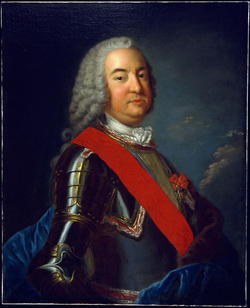
Pierre de Rigaud was born in Québec the 22 of November 1698. The fourth son of soon-to-be governor-general Philippe de Rigaud, marquis de Vaudreuil, and Acadian noble wife, Elisabeth de Joybert, Pierre followed the established aristocratic tradition of military service as early as 1706, when he served as an ensign in the French colonial army in Canada. He was made lieutenant in 1711, and soon after left for France carrying dispatches as a midshipman. With the help of his mother, who had been appointed under-governess to the children of the duc de Bourgogne, a grandson of Louis XIV, Pierre attained the grade of captain in 1715 and major general by 1726.

The young Pierre de Rigaud made a return voyage to Canada to settle his late father's estate in 1726. He probably accompanied his mother from Québec to France in 1728, where he was decorated with the highly coveted royal and military order of Saint-Louis the following year.  His first administrative position in French North America was that of  governor of the town of Trois-Rivières, situated between Québec and Montréal, a post granted to him in 1733. The death of his mother in Paris called for a return to France in 1740. Again he was awarded a new colonial position: the governorship of Louisiana. He arrived in New Orleans in 1743, and would serve in this capacity until 1753. Well-liked, the marquis and his wife were known for throwing elaborate parties and balls, including what might have been the first pre-Lenten carnival festivities in New Orleans. Pierre de Rigaud also helped stimulate the economy of French colonial Louisiana, introducing indigo production and encouraging the cultivation of rice and tobacco. He also turned a blind eye to Franco-Spanish smuggling, thus helping the colony stay alive economically. 

Pierre de Rigaud received word that he would be replaced as governor of Louisiana in 1753. He returned to Paris with his wife, and the couple lived in the capital until 1755 when he was finally named governor-general of New France. This most prestigious of colonial administrative positions granted him authority over all of France's North American empire, at least on paper.

PictureJeffery Amherst, 1758
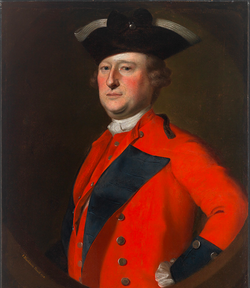
The first and only governor-general to be born in New France, he was also the last. He assumed office only a year before the outbreak of the Seven Years' War, an international conflict that would end in the loss of Canada to the British. Upon his arrival in Québec in 1755, British and Anglo-colonial forces had already made attacks and incursions on settlements and territories claimed by France. Vaudreuil and the marquis de Montcalm, the commander of the French forces deployed to save New France, did not see eye to eye. This disagreement did not serve either party well, with Vaudreuil preferring guerrilla combat and Montcalm expecting European-style warfare. Although French victories marked the early years of the War, British forces under James Wolfe took the fortress of Louisbourg in Nova Scotia in 1758; this key maritime center was all the stood between them and the opening of the Saint Lawrence River. Within a few days, they would be at the gates of Québec, which fell in September of 1759. Montcalm was killed during the siege; Vaudreuil had left to take charge of Montréal.

Vaudreuil surrended Montréal to the British under Jeffery Amherst in 1760. He returned to France, where he was blamed for these major territorial losses.  Imprisoned in the Bastille for a few months in 1762, he was soon freed and exonerated of all charges. Louis XV would cede almost all of France's North American possessions to Great Britain and Spain in 1763 with the signing of the Treaty of Paris.  Pierre de Rigaud and his wife lived in what is now the Marais district in Paris. Their urban townhouse stood in the rue de Tournelles, a few blocks from the Bastille in the parish of Saint-Paul. The widowed marquis de Vaudreuil lived on a pension of several thousand livres from the king, tended to by a daughter of the marquis de Montcalm.

0 Comments

The 1720s château

6/12/2013

0 Comments

 
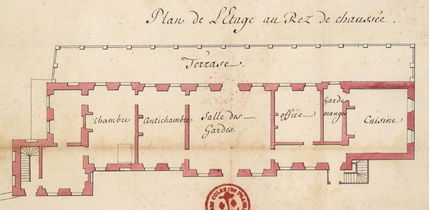
Picture1719 plan, Archives nationales d'outre-mer (ANOM), Aix-en-Provence, France
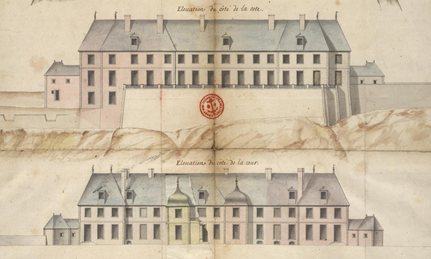
In 1719, the château Saint-Louis retained a certain military character inherited from the previous century of war and the struggle for survival.  At its core stood a salle des gardes (guardroom) flanked by a chambre (bedchamber) and antichambre (antechamber or anteroom) for the governor to the south and an office (pantry), garde manger (larder), and cuisine (kitchen) to the north. This configuration dated to circa 1700, when the governor-general, the comte de Frontenac, ordered a new stone residence built to replace the first château, a composite wood-stone structure built under the tenue of Charles Huault de Montmagny in 1647. For Frontenac, the governor-general's residence was an important symbol that consolidated his authority. Renovation of the château began in 1694 and signaled a new chapter in the history of the site. Although the first château Saint-Louis had been built to withstand English and Iroquois attack, Frontenac's new château emerged as a symbol of royal prestige and the refinement of the governor-general.

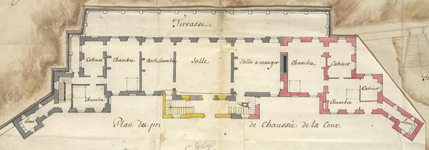
Picture1724 plan, Archives nationales d'outre-mer (ANOM), Aix-en-Provence, France
Returning to Québec in 1716 after two-year sojourn to France, Governor-General Philippe de Rigaud, marquis de Vaudreuil (and father to Pierre de Rigaud), continued Frontenac's vision for an entirely refurbished château. Gaspard-Joseph Chaussegros de Léry, the king's engineer posted to Canada, undertook a new design in the 1720s, which incorporated the earlier 1690s structure as a southern wing for the governor's apartments.

The 1724 floor plans bear witness to changes in elite colonial lifestyle and new social codes to which the colonial administration was expected to adhere. Rather than entering a guardroom, visitors to the new and improved château Saint-Louis found themselves in a salle, a multipurpose space that translates literally to "room" but is likely the salle de compagnie, or public entertaining space, documented in Pierre de Rigaud's 1771 inventory. Adjoining this space was a salle à manger (dining room). In a society where most people ate wherever they could find a seat, having a room designed and designated for dining purposes was extremely fashionable and harkened to metropolitan innovation. Access to the governor's bedchamber, reserved for important guests and used for business as much as sleeping, was buffered by an antichamber.

Philippe de Rigaud was the first governor-general of New France to inhabit the château with his family.  Forty-seven years of age when he married an Acadian-born noblewoman, the seventeen-year old Louise Élisabeth de Joybert de Soulanges et Marson, in 1690, Vaudreuil fathered nine children who were raised within the walls of the château and in various religious institutions in Québec. Like the king and queen at Versailles, noble couples typically occupied separate chambers in elite homes, a fact underscored by the 1724 floor plan of the château Saint-Louis. Relegating the earlier kitchen, pantry, and larder to the cellars, Chaussegros de Léry designed a new southern pavilion (outlined in pink) to house the marquise's apartments, consisting of a suite of three bedchambers and a cabinet.  This smaller, discreet space could be used as an office, a dressing room, for devotions and prayer, or for quiet study and intimate conversation.

Period correspondence reveals the important role played by the marquise de Vaudreuil in renovating the château in the early eighteenth century. Although Frontenac launched the major renovation and reconstruction of the château, I'm interested in learning more about the marquise's  requests for rooms, servants, and a personal apartment.

0 Comments

Bienvenue

6/12/2013

2 Comments

 
Picture1724 plan, Archives nationales d'outre-mer (ANOM), Aix-en-Provence, France
Welcome to my blog! My name is Philippe Halbert and I am a Lois F. McNeil Fellow at the Winterthur Museum. Fellows are students in the Winterthur Program in American Material Culture, a graduate (MA) program jointly administered by Winterthur and the University of Delaware. I'm beginning this summer by participating in the Delaware Public Humanities Institute (DelPHI). DelPHI fellows learn about and practice public presentation and interpretation skills, including giving radio and television interviews, drafting grants, and using social media. This blog began as an in-class activity, and I'll be using it to chart my thesis research and share interesting images and findings. Thanks to a generous grant from DelPhi, I'll be traveling to France and Canada this summer as I chart the oft-forgotten history of decorative arts and material culture in New France, which existed roughly from the 1530s through the 1760s. This immense swathe of territory stretched from Canada and the Great Lakes to the Rocky Mountains and the Mississippi River Delta.


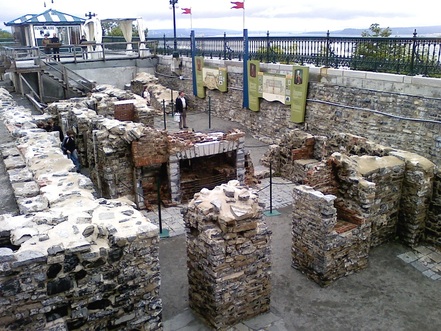
The challenge of my work centers on the fact that the buildings that held important furnishings no longer exists. Rebuilt and remodeled several times before it burnt to the ground in 1834, the château Saint-Louis was the grandest and most important secular building in French colonial Canada. This "castle" dominated the cliffs of Québec City, capital of New France, and was the official residence of the colonial governors-general. A wooden fort built by Samuel de Champlain stood on the site as early as 1620, and a stone château, begun in 1648 and rebuilt in 1694, was part of a larger fortification- the fort Saint-Louis- built for defense. The 1694 château would be further enlarged in the 1720s and can be seen in the 1724 plan above.

The intendant's palace burnt several times during the French colonial period and during the bombardment of Québec in 1759. The first official residence for the intendant was conceived within a preexisting brewery in the 1680s. When this building burned in 1713, a new "palace" was built from 1715 to 1716, and renovated after a fire in 1726. What remained  after the British bombarment of 1759 was destroyed in 1775 during an American invasion, and ruins stood on the site until they were razed to build a brewery.

Functioning like a courts in miniature, these structures  housed dozens of soldiers, servants, and slaves called upon to protect and tend to the governors and the intendants , their families, and a multitude of live-in guests including French envoys, Amerindian emissaries and adopted children, and even New Englanders brought to New France as captives. Fine furniture and interior decoration underscored the significance of the château St-Louis and the intendant's palace as administrative centers that reflected absolute monarchical power.

I'm focusing my research on the period 1725, when the structures' final forms under the French regime were completed, to 1760, when British forces took Canada. Several French governors and intendants left behind valuable records related to their furniture, other interior furnishings, and the staff employed to care for them.  Philippe de Rigaud, marquis de Vaudreuil, took up residence as governor-general of New France with his wife and nine children in 1703. He died at the château in 1725, but not before ordering major refurbishment of the structure, both inside and out. His 1726 probate inventory lists an impressive amount of furnishings, including more than one hundred pieces of seating furniture ranging from simple rush seat chairs to elegant upholstered armchairs and a sedan chair.

Charles de La Boische, marquis de Beauharnois, assumed office in 1726. He returned to France in 1747 with a large amount of furniture, books, silver, and ceramics, all stored in the port town of Brest and auctioned off at his death in 1749. Records from the period of Beauharnois reveal the hiring of staff to maintain and protect the governor's furnishings from the 1720s to the 1740s, and bills from the 1730s reveal important renovation to spaces within the château.

One intendant, Claude-Thomas Dupuy, left spectacular records behind that detail the sale of his furnishings. A bourgeois magistrate hailing from the Parisian court, Dupuy ordered extensive addition to the palace and arrived in Canada with a staggering amount of furnishings and decorative fixtures. Unfortunately for Dupuy, tensions mounted between him and the governor, so much so that he was recalled in the fall of 1728. Having amassed significant debt, his property was seized and sold at auction in 1730 and 1731. Records from this sale survive and detail the presence of 91 pieces of mirror glass, over a dozen gilt console tables, tapestries, sculpture, a pipe organ, hundreds of books, scientific instruments, and other items at the palace during Dupuy's intendancy.       

The last governor of New France and Philippe's son, Pierre de Rigaud, marquis de Vaudreuil-Cavagnial, bought clocks, tapestries, furniture, and gilt fixtures at personal expense in Paris for use in Québec.  He didn't have long to enjoy them, as France and Great Britain declared war a year into his term.  He and his wife the marquise remained at the château until September of 1759, when the British attacked Québec; retreating to Montréal, the governor ordered for valuables to be left in the château's vaults for safekeeping. Within days of the siege, his effects, furnishings, and provisions had all gone missing.  Returning to France in 1760,  Pierre de Rigaud would spend the next decade petitioning both French and British ministers for the cost of his furnishings.  An unpublished 1771 inventory drafted from his memory and conserved by the British National Archives is an exciting document that will help to tell this story. 

Studying the furnishings of the château Saint-Louis and the intendant's palace through these documents, letters, surviving objects, archaeological artifacts, and architectural plans will help to bring these long-vanished buildings and the stories of their inhabitants to life. 

Picture
The excavated ruins of the château Saint-Louis
2 Comments

    Archives

    February 2016
    January 2016
    December 2015
    September 2015
    July 2015
    June 2015
    May 2015
    January 2015
    May 2014
    April 2014
    February 2014
    January 2014
    October 2013
    September 2013
    August 2013
    July 2013
    June 2013

    Àbout:

    A graduate student with an interest in the people of the past and their things

    Catégories

    All

    RSS Feed

Powered by Create your own unique website with customizable templates.