Power Houses: Furnishing Authority in New France,  1660-1760
  • Home
  • Blog

Point de Hongrie

8/31/2013

2 Comments

 
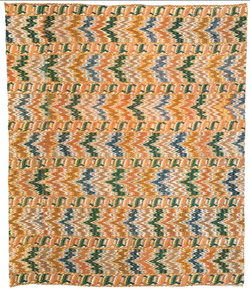
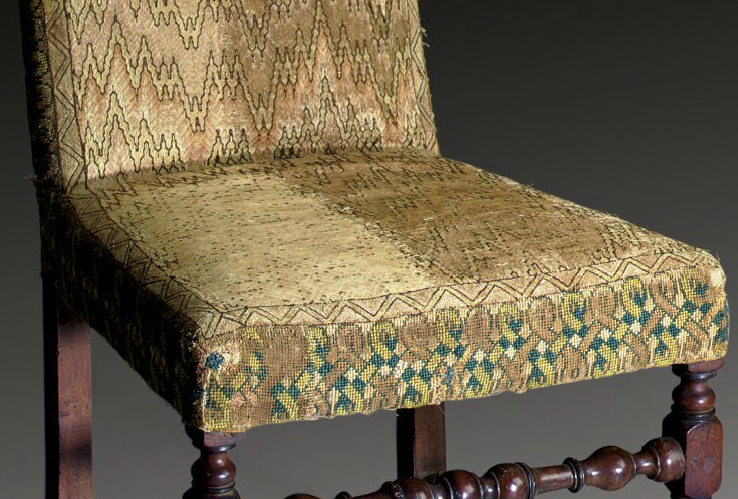
PictureSeventeenth-century point de Hongrie needlework
Before coming to Winterthur, I never saw myself as a textile person. I love historic interiors, and saw furniture as the primary player in the curatorial creation of accurately furnished bedchambers, dining rooms, and parlors in historic house museums and period rooms. Sure, other types of objects were there and certainly important, but for me, furniture was the greatest thing ever. Wrong.

In the seventeenth and eighteenth centuries, notaries in charge of compiling probate inventories and other records spent an overwhelmingly greater time listing and describing...textiles! On the whole, textiles were the most expensive and valuable furnishings that a person could own. I've definitely come to better appreciate them, especially as they relate to furniture. After all, what is a bed without bedhangings or an upholstered armchair without upholstery?
Taking a Louis XIV-era fauteuil, or armchair, as an example, the choice of upholstery textile could dramatically increase the value and prestige of seat, perhaps even more so than its elaborate carving.

The seizure papers for Intendant Claude-Thomas Dupuy's estate are replete with documentation of furnishing textiles- the "soft furnishings" that I posted on earlier this summer- including type, color, and even geographic origin. If only the adjectives used to describe other objects in the palace were more descriptive! At the intendant's palace, point de Hongrie textiles were among the most visually striking kind used, figuring on everything from bed curtains to curtain tie-backs (either for a bed or for window curtains or portières). This post is a brief introduction to point de Hongrie, or Hungarian stitch. This type of needlepoint embroidery is characterized by a series of chevron shapes, achieved using a mathematical stitch pattern, and is sometimes referred to as flame-stitch or Bargello work.
Picture
Louis XIII chair with possibly original point de Hongrie upholstery on the seat and back
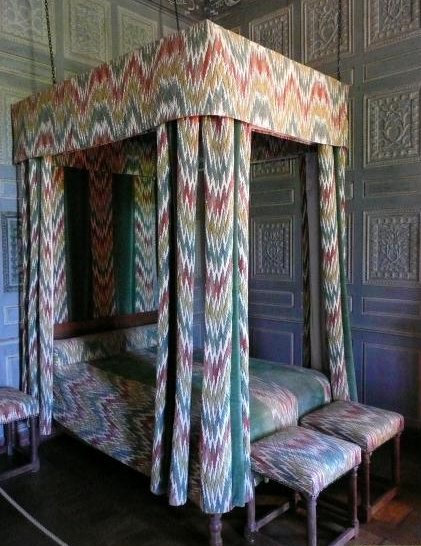
Despite an ostensible Hungarian origin, point de Hongrie pattern textiles appear to have originated in Florence and began to be produced in France by the second quarter of the seventeenth century. Wool was a cost-effective choice, and more luxurious point de Hongrie designs could be made from silk. At the palace, Dupuy owned several yards point de Hongrie tapestry, and two twin beds were outfitted with silk point de Hongrie hangings. A seventeenth-century bed at the Norman château de Carrouges illustrates the use of this textile for bedhangings and in the upholstery of several stools. It is likely that some of the palace's furniture was upholstered in point de Hongrie, and the yards of the fabric mentioned in the report might refer to unused upholstery material. Alternatively, it could have been used to cover the walls of a chamber, perhaps that which held the two beds hung with silk point de Hongrie hangings.  
Picture
Château de Carrouges, Carrouges, Basse-Normandie
2 Comments

The Material Culture of Music in Colonial Québec

8/29/2013

1 Comment

 
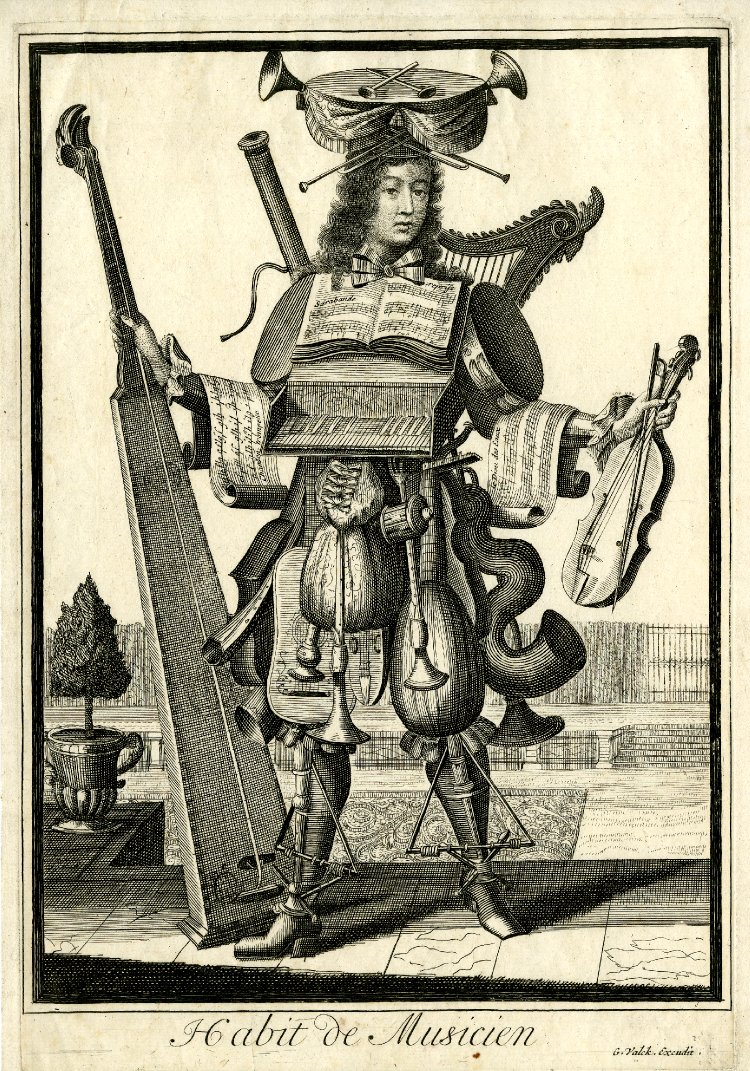
PictureHabit de Musicien, circa 1700
Music and aural experience are two things that material culture scholars are now beginning to address in their studies.  Such objects represented more than just diversion to their original owners. Given their physical size, larger musical instruments such as keyboards had to be integrated within interior spaces and worked together with surrounding furnishings. Less bulky stringed instruments and woodwinds could be stored in special cases; however, the elaborately tooled leather examples that survive point to the value of the objects that they contained and the protection that they required.

Symbolically, music was an important element of elite identity in seventeenth- and eighteenth-century France. Musical skill was a privilege that denoted fortune enough to pay an instructor as well as time in which to engage in the pursuit of such leisure.  As proper deportment allowed one to wear a fashionable gown or suit with ease and grace, successful musical performance indicated bodily control and order.  Colonial consumers in New France replicated these metropolitan values. The upper echelons of colonial society enjoyed balls, concerts, and theatrical performances marked by a variety of musical instruments. The grandest such events took place at sites such as the château Saint-Louis and the intendant's palace. As the administrative, military, and spiritual capitals of New France, it is appropriate that Québec also played host to important cultural events, including those of a musical nature.     

Picture
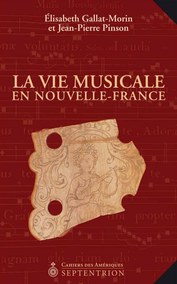
A history of music in the colony was published by Elisabeth Gallat-Morin and Jean-Pierre Pinson in 2003. This monumental work delves into religious and secular musical traditions that marked early Canada, from motets and vespers sung in religious communities to the libretti of courtly operas owned by the likes of Intendant Claude-Thomas Dupuy. Although Dupuy's musical tastes have been examined by Gallat-Morin, no comparable English study has been published. My research takes a different approach to looking at musical instruments by considering them as part of the palace's furnishings. 

A connoisseur of baroque music, Dupuy owned copies of works by the very best French and Italian composers.  These are listed along with the several hundred volumes of books in his library. The 1726 floorplan of the palace shows that an actual room was used as a library.  Unlike Philippe de Rigaud, Dupuy also owned an impressive collection of musical instruments. The governor's probate inventories curiously list no musical instruments or sheet music. His successor and Dupuy's sworn enemy, the marquis de Beaharnois, is known to have held elaborate social gatherings at the château. No list of Beauharnois' furnishings in Canada is known to exist, and perhaps the governors hired musicians to play for these events.

Judging from his inventory, Dupuy was a fan of one of most important- and one of my favorite- French baroque composers of the seventeenth century: Jean-Baptiste Lully (1632-1687). This Florentine-born musician came into the Louis XIV's service in the 1650s, remaining until his death from infection after piercing his foot with his director's staff during a performance (what a way to go). The first French-style operas were composed by Lully, and the intendant owned copies of every one of his operas in addition to several psalms set to music. Lully's work set the tone for contemporary French composers and others through the early eighteenth century. He was, for all intents and purposes, a rock star.

Picture
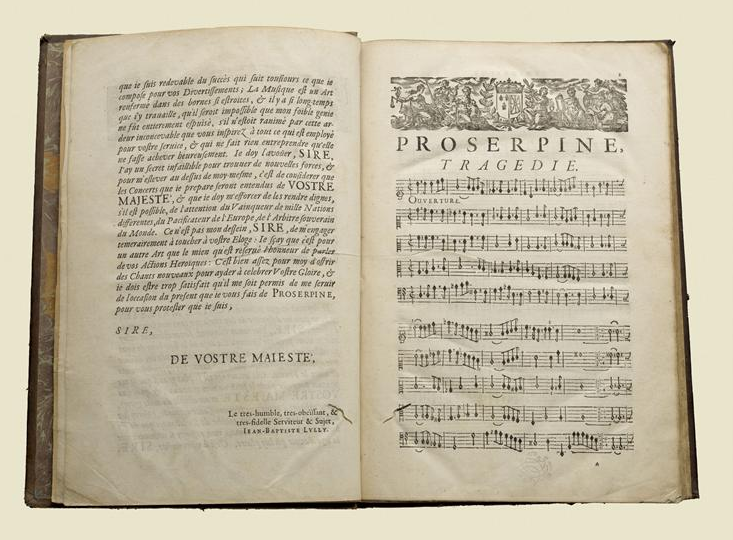
1680 edition of Proserpine, a tragédie en musique (musical tragedy) by Jean-Baptiste Lully, similar to that owned by Dupuy
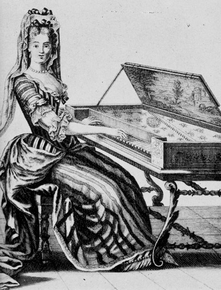
PictureLady at a harpsichord, 1688
Below are two versions of one of Lully's most popular tunes, a passacaille or dance from the tragedy Armide; Dupuy owned a copy of the libretto by Philippe Quinault and the score by Lully.  The first clip is from an orchestral performance in the Hall of Mirrors at Versailles; this is close to how the piece would have sounded during the opera's 1686 début. The second video is a harpsichord performance of the same passacaille reworked for keyboard by Jean-Henri d'Anglebert (1629-1691). The harpsichord replicates the sound of a spinet like the one owned by Dupuy. A "petite Epinette portative de deux pieds 1/2 de longeur un pied 1/2 de hauteur" ("a small portable Spinet two feet long and one and a half feet high") was among the items seized at the palace to pay Dupuy's debts in 1728. Although suitable for both sexes, keyboards along with guitars were a favorite instrument for ladies. Perhaps Madame Dupuy, born to a well-to-do Parisian bourgeois family, took keyboard lessons and played Lully on the spinet, accompanying her husband on the viol.

Essentially a smaller version of the larger harpsichord, the spinet is a keyboard instrument whose keys are activated by plucking the strings rather than hammering then, like in a piano. Spinets were portable instruments; the actual keyboard and case- the box containing the soundboard and strings- could be simply set upon a base, or come attached.
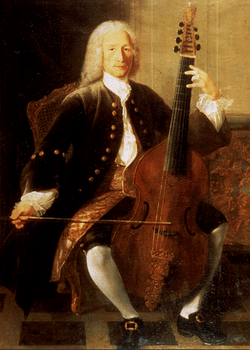
Picture Jean-Baptiste Forqueray, 1737
A variety of motets by French and Italian composers such as Paolo Lorenzani (1640-1713), André Campra (1660-1744), Nicolas Bernier (circa 1665-1734), and Louis-Nicolas Clérambault (1676-1749) could also be found in Dupuy's library. Copies of instrumental works also included sonatas by more contemporary French and Italian composers as well as the works for viol or viola da gamba by Marin Marais (1656-1728) and a treatise on bagpipes.

Marin Marais was another prolific French composer of the late baroque era who also held royal appointments at Versailles. His most famous pieces are those for the viol; Marais'
 first book of viol music was published in 1686, and four more followed into the 1720s. Dupuy owned "Deux Basses de Violle Angloises avec leurs Etuys et archets" ("Two English Viols with their Cases and bows") in 1728; his probate inventory from 1738 also includes viols, indicating a possible preference for the instrument. It is likely that he played, the viol being a popular instrument for men and even some women.

Below are samples of two works by Marin Marais. The second video is from one of my fave movies, Tous les matins du monde, a biopic of the composer, and features Marin Marais' reworking of the traditional folia. It's always fun to see an instrument in action!

The viol was renowned for its expressive, emotional qualities; it was said to capture everything from sighs to sobs. The following piece for two viols was composed by Marin Marais in 1686. Led by American director Skip Sempé, Capriccio Stravagante is one of my favorite baroque ensembles. It is easy to imagine this piece being played at the palace, perhaps by Dupuy and his wife.
PicturePortable chamber organ, Italian, 1651
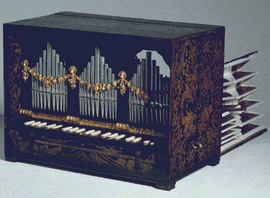
The most imposing of Dupuy's musical instruments was a "Grand Cabinet d'Orgues contenant douze jeux" (a Large Cabinet for a chamber organ with twelve stops). Because the intendant's property was seized for immediate sale, the various objects' location within the palace was not recorded. It is plausible, however, to conjecture that such an instrument would have been placed in a prominent public room of the building, such as the salle, especially given its location within a cabinet. The actual organ possibly resembled a 1650s example now in the collection of the Cité de la musique in Paris. 

PictureCabinet for an organ, circa 1700
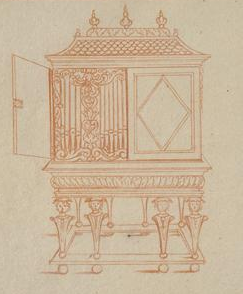
A circa 1700 red chalk illustration, from the album Décoration intérieure et jardins de Versailles, depicts such an organ contained within a Chinese-style cabinet set upon a more baroque-style stand. When closed, the instrument's case resembled a piece of case furniture, like an armoire, thus inserting itself into the wider decorative scheme of the room in which it was placed.


The composer Clérambault composed for the organ, which figured in both sacred and secular music of the period. Below is a secular tune by the composer played on an organ that might have been familiar to Dupuy.

Notes and sheet music for popular pastoral airs, known as brunettes, were also present at the intendant's palace. Jean-Baptiste Drouart de Bousset (1662-1725), a composer who assembled and reworked many such traditional songs, was cited in the inventory. Below is one of my favorite brunettes, sung with attention to period pronunciation and syntax of the early eighteenth century.
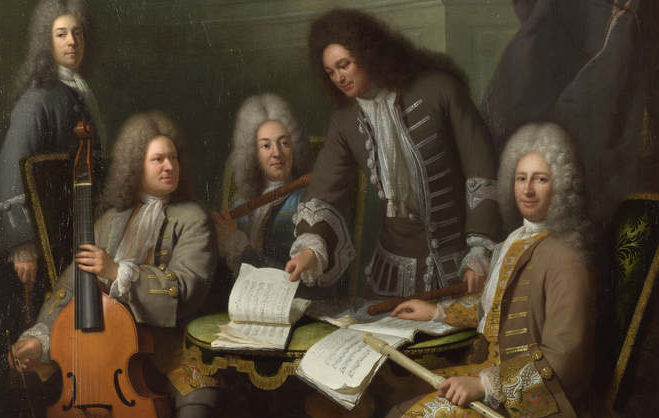
The role of music at the intendant's palace cannot be downplayed (no pun intended) during the intendancy of Claude-Thomas Dupuy.  If an overdoor tapestry of a concert recorded in 1728 were not enough, musical instruments, especially the organ and spinet, were important features of the palace's interior decoration and certainly influenced room usage by Dupuy, his wife, and their guests.
Picture
Group of Musicians, circa 1710
1 Comment

The Mystery of "Jules Romain"

8/22/2013

0 Comments

 
Picture
Detail, late seventeenth-century tapestry, Gobelins, Paris
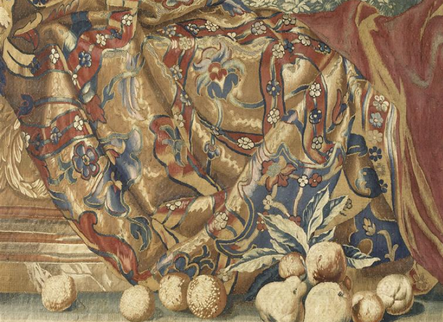
It is perhaps no surprise that many French colonial inventories make reference to tapestries and other decorative textiles. Placed upon walls and used to upholster furniture within elite homes and public buildings, they served a dual function similar to their medieval-era predecessors; demonstrative of wealth and prestige, tapestries also provided insulation during the bitter cold of Canadian winters.

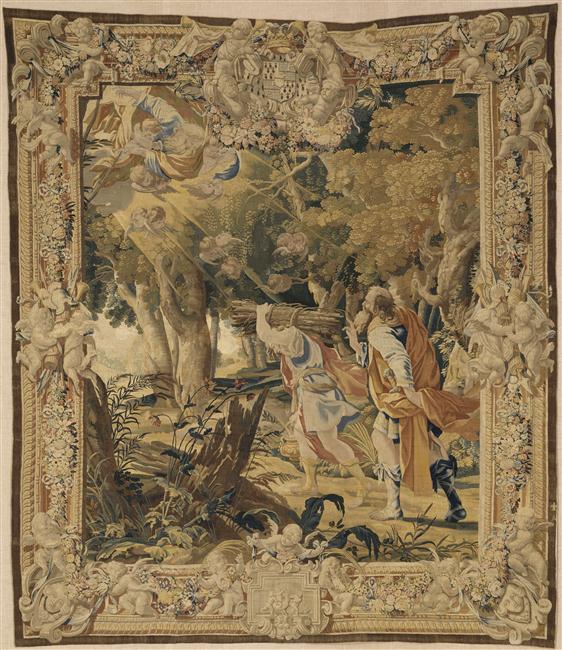
I've blogged before about the use of tapestry at the château Saint-Louis. This post will present a case study drawn from the intendant's palace. Unlike the documents associated with governors-general Philippe and Pierre de Rigaud, those for Intendant Claude-Thomas Dupuy go into specific detail regarding the decorative tapestries that adorned the walls of the intendant's palace before being seized by the state in 1728. Sold at auction to pay off his debts, Dupuy's collection of tapestries included examples from the very best French and Flemish textile manufactures: the Gobelins of Paris, founded in 1662, Beauvais, founded in 1664, and various centers in Flanders such as Bruxelles, a traditional source for fine tapestries. The records also go into detail regarding the subjects depicted, which range from a concert and hunting parties to Biblical scenes. Five Flemish tapestry panels owned by Dupuy depicted the story of Abraham  with "figures plus hautes que nature" ("larger than life figures") and "sur les dessins de Jules Romain" ("based on the drawings of Jules Romain").
Picture
Abraham's Sacrifice, 1630s, tapestry inspired by a painting by Simon Vouet, Amiens
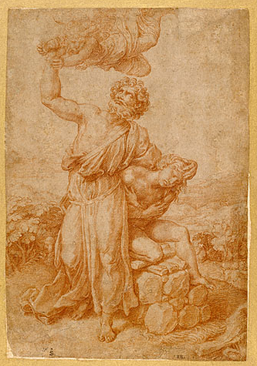
PictureThe Sacrifice of Isaac, Giulio Romano, circa 1516-1518
Lifted from the Old Testament book of Genesis, Abraham and his son Isaac form a staple of the Western art historical canon. Considered the founding father of the Israelites, Abraham holds a prominent place in the Judeo-Christian tradition and in Islam. A popular theme in Renaissance and Baroque art, his story was often reproduced in textile form, including crewel embroidery and tapestry. A French tapestry of wool and silk woven at Amiens in the 1630s provides one such example. But how closely does this wallhanging resemble Dupuy's tapestries of Abraham?

The note regarding Jules Romain provides the incredible opportunity to seek out the original drawings upon which the palace tapestries were based. Although tapestry subjects were often described in French probate records, few identify the artist responsible for the original artwork. "Jules Romain" is likely Giulio Romano (circa 1499-1546), a Renaissance-era artist who was born and worked in Rome. Dupuy's extensive library included works and music by Italian writers and composers with Frenchified names; it is likely that this practice was applied to an Italian artist like Romano.

A red chalk drawing by Romano exists in the collection of the Getty Museum and depicts the sacrifice of Isaac. An engraved version of the same image is at the Metropolitan Museum of Art. Depicting the dramatic moment where Abraham nearly sacrificed his only son after being called to it by God, it is impossible for this scene to not have been included among the five panels of Dupuy's Abraham tapestries at the intendant's palace. Romano is known to have designed tapestries in his lifetime, and sent drawings of potential subjects to Flanders. I have yet to find how long his drawings served as inspiration to Flemish weavers, which could help determine whether Dupuy's tapestries were "antique" examples from the sixteenth century, or were later iterations of his work dating to the seventeenth or eighteenth centuries.

I haven't found other examples of Romano's history of Abraham, but this is a step in the right direction! Tapestry versions of his work that survive include scenes from Classical Antiquity, such as the Battle of Zama, created in the 1530s. Unfortunately, a number of known Romano tapestries were destroyed during the French Revolution for their gold and silver threads.

I'll also be checking the official reports of the Dupuy estate sale, held in October of 1730 and continued in June of 1731, to see if the five Abraham tapestries sold and who might have bought them. Five panels of Flemish tapestry lined with a green toile were sold over the course of first sale in 1730; these were acquired by Sieur Claude-Gabriel Walon de Messi, a noble merchant and contrôleur de la maison du roi (in addition to being one of Dupuy's creditors and one of the largest buyers at the auction), for the sum of 3600 livres. An account dating to October of 1736 describes how several Flemish tapestries belonging to Dupuy remained unsold and stored in a garret of the palace. Either of these anecdotes could refer to the Abraham tapestries inspired by Giulio Romano.

0 Comments

"le Buste du Roy en marbre"

8/9/2013

0 Comments

 
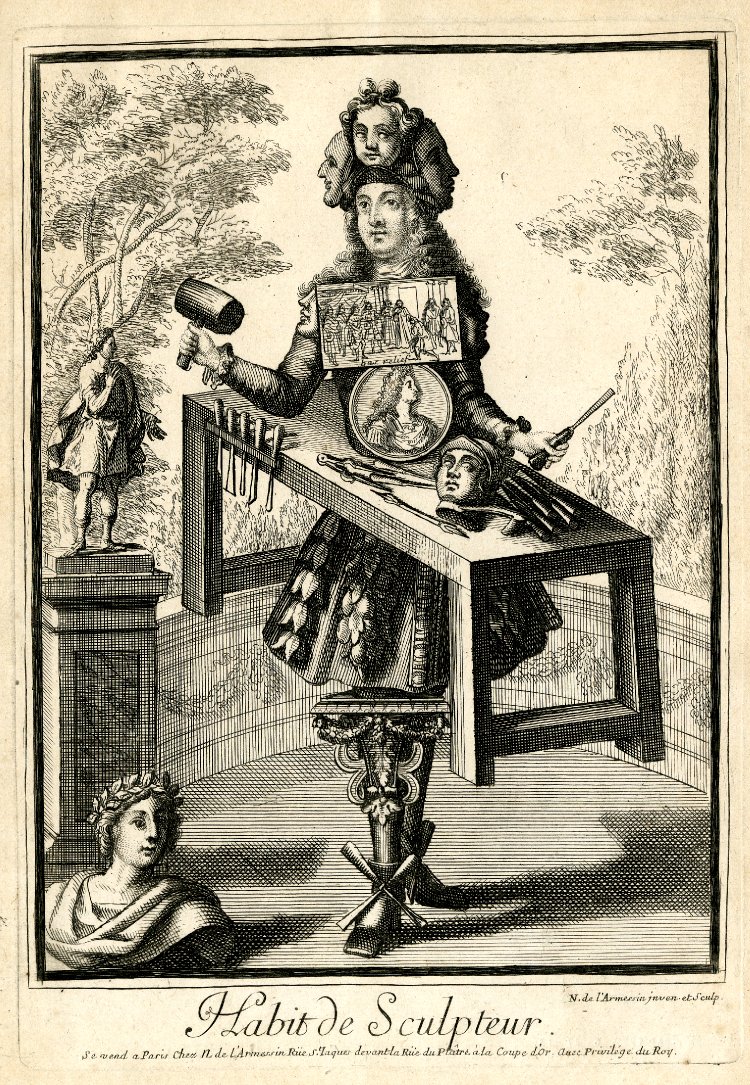
PictureHabit de sculpteur, circa 1700
Among the more interesting items known to have adorned the intendant's palace in Québec was a marble bust of the king ("le Buste du Roy en marbre"). This bust, along with one of his mother and a family portrait by Nicolas de Largillière, was among the few things that the intendant Claude-Thomas Dupuy was allowed to keep after the confiscation of his property and his return to France in 1728.

Picture
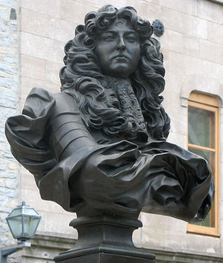
Dupuy was not the first intendant to bring a royal bust to Québec. Jean Bochart de Champigny, intendant from 1686 to 1702, arrived in New France with a bust of Louis XIV.  Unlike Dupuy's marble bust, Champigny's was of bronze and destined for outdoor display in the  square of Québec's Lower Town. After much ceremony, the bust was installed in November of 1686 and the square renamed Place Royale. Maps and illustrations of Québec do not fail to include the bust, which remained at Place Royale until 1700. Complaints centered on its being in the way on market days, and the bust either returned to France with Champigny or was destroyed when the intendant's palace caught fire in 1713. France offered a new bust to Québec in the 1930s, which can be seen at Place Royale today (although it, too, was removed for being in the way until finally assuming a permanent home in 1948).

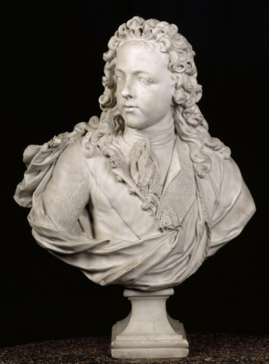
PictureBust of Louis XV, Antoine Coysevox, circa 1719
Although the bust returned to France with Dupuy and was subsequently lost to history, clues exist that can help to visualize its appearance. When Dupuy arrived in New France in September of 1726, the king of France was the sixteen year-old Louis XV (1710-1774), the only surviving great-grandson of Louis XIV (1638-1715).  My opinion is that Dupuy's bust was of Louis XV and not his exalted great-grandfather, the "Sun King." The seizure documents at the French colonial archives refer to the bust as being "the king's," not the "former king's" or the "late king's." Furthermore, Dupuy was appointed intendant by Louis XV, and the display of the royal image in the intendant's palace, possibly in the council chamber, would have been in keeping with period practice. At Louisbourg, for example, a portrait of Louis XV could be seen in the chamber reserved for the Sovereign Council- more of a court of appeal for the colony of île Royale- in the king's bastion under the governor's apartments.

With my supposition that Dupuy's royal bust depicted Louis XV, it is likely that it was the work of sculptor Antoine Coysevox (1640-1720). Coysevox's bust of the king, sculpted circa 1719 when he was nine years of age, is the best candidate for a number of reasons, including Dupuy's known relationship with the sculptor. Among the items brought to Canada by the intendant was a two-foot tall white marble medallion. The medallion's gilt border framed an inscription that read "par Ant. Coysevox, pour marque singulière de son amitié" (by Ant. Coyesvox, as a singular mark of his friendship).

I have yet to find a bust of Louis XV any earlier than Coyesvox's 1710s model. As the king only ascended the throne in 1715 at the age of five, and in light of Dupuy's friendship with the sculptor (who died in 1720), I think that this conjecture is plausible. A surviving example of the Coysevox bust can be seen in the collection at Versailles, and the Louvre owns a model in terra cotta.

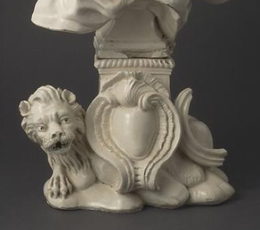
PictureBase of a later bust of Louis XV featuring a lion
 The seizure papers for Dupuy's estate detail that "le pied du Buste du Roy [est] composé de quatre Lions qui appuyent un pied-douche des Cartouches et des trophées d'armes" ("the base of the King's Bust [is] composed of four Lions pressing against a pedestal of Cartouches and trophies of weapons"). In contrast, the bust of Dupuy's mother, Elisabeth Dupuy, née Aubry (1640-1716), was displayed on a four-foot tall marquetry pedestal.

I haven't found anything matching this description in a modern-day collection, but a pair of circa 1745 busts of Louis XV and his Polish-born queen, Marie Leczinska, each showcase a lion at their base. These busts are made of tin-glazed earthenware (faïence) and are based on models prepared by Jean-Baptiste II Lemoyne (1704-1778).

Dupuy's bust must have been an impressive sight! In addition to being visually striking, such an object would have helped to underscore the power of the intendant, sent to Canada by royal appointment, over judicial and economic affairs in the colony. Although a bourgeois, by all accounts Dupuy used furniture and decorative objects to set an aristocratic tone worthy of Versailles in ways that mirrored his non-noble peers in France, to say nothing of actual noblemen and women. The rise of the Parisian bourgeoisie had its origins at the turn of the eighteenth century, and bourgeois financial ventures, combined with administrative service, made for a society that was beginning to accommodate mobility within the hierarchical structure of the Ancien régime.

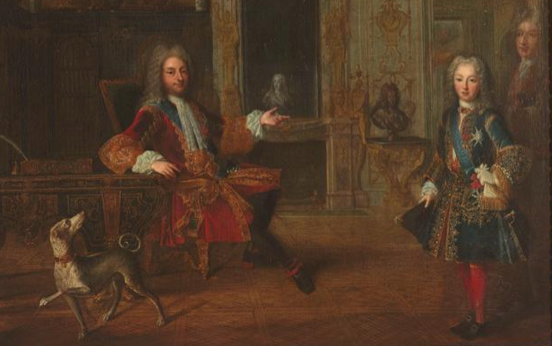
Below is not the best quality image, but one that shows the regent for Louis XV, his cousin Philippe d'Orléans, with his son placed in front of two busts. The bust occupying the place of honor over the fireplace is that of Louis XV. A bust of Louis XIV can be seen just to right on a small console. The primacy of Louis XV's bust is clear, and the one depicted in this painting by an unknown French artist is almost surely a model by Coysevox.

Picture
Le régent, représenté dans son cabinet de travail avec son fils le duc de Chartres, circa 1720
0 Comments

Engaging the Public through Living History

8/9/2013

2 Comments

 
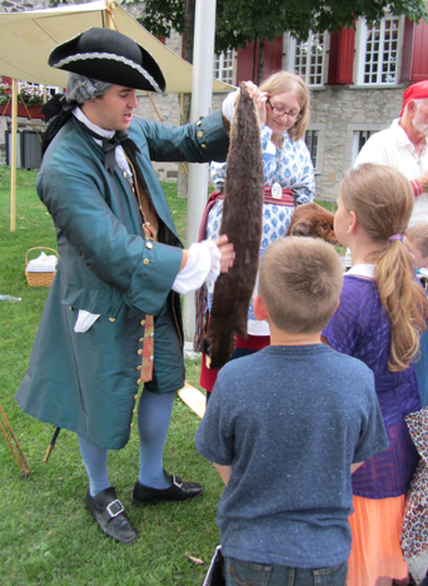
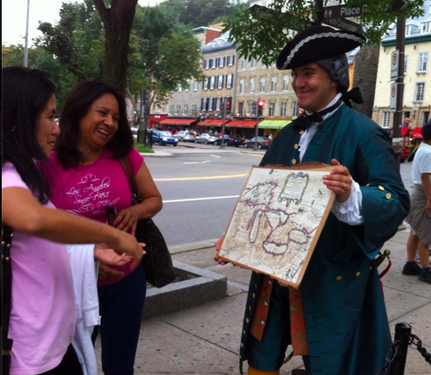
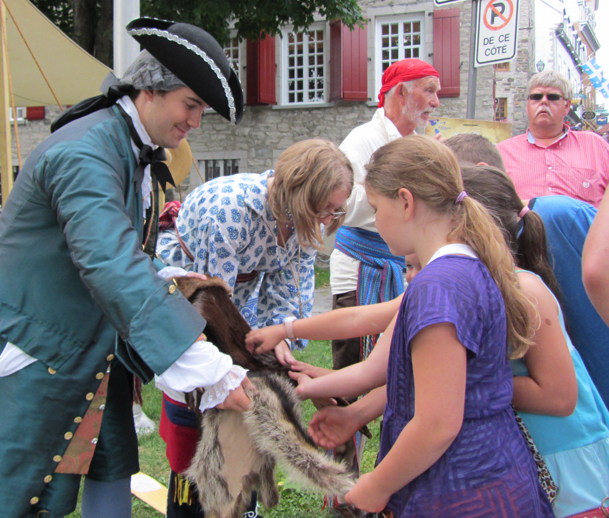
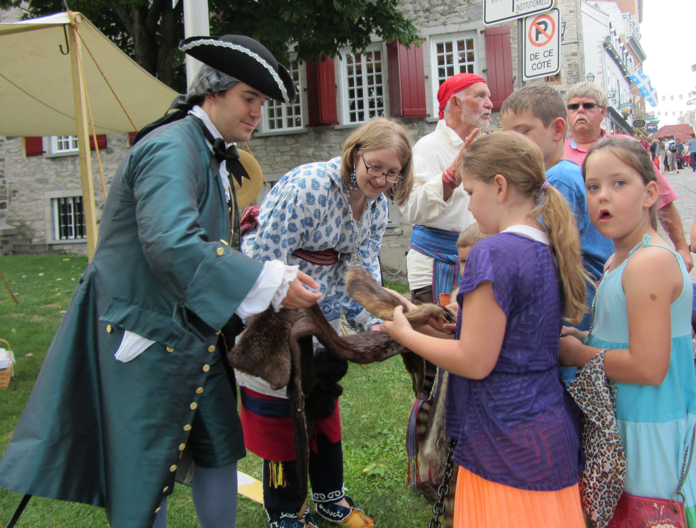
PictureIdentifying furs and discussing the economy of New France
Learning how to effectively engage your audience through various media is an important part of the DelPHI experience. When applying for the fellowship, students are asked to keep in mind the needs and interests of the non-specialist public. Consequently, we are required to implement some form of public outreach related to our research, whether a blog, workshop, or other program.

I was lucky in that my research trip to Québec coincided with the annual Fêtes de la Nouvelle-France, or New France Festival, in the historic district of Québec City. This year's festivities are marked by the 350th anniversary of the arrival of the Filles du Roi, or the King's Daughters. Sent to New France to help populate the colony, approximately 800 women were recruited by Louis XIV between 1663 and 1673; the king paid each girl's dowry and passage to North America. Many French Canadians draw ancestry from one or more of these women.

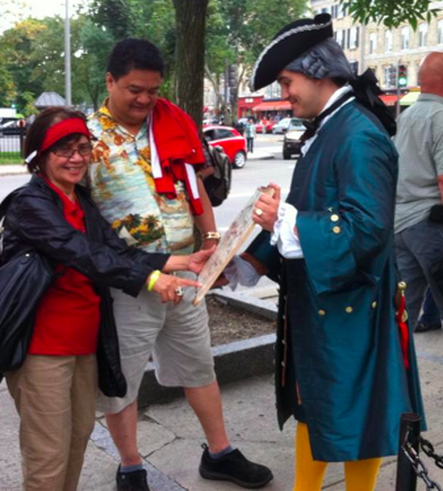
PictureTheir hometown is not on this map
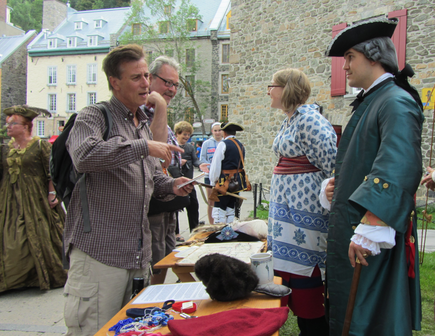
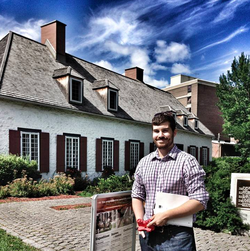
For my public engagement project, I joined up with a friend, Joseph Gagné (who runs this incredible site on digital New France, www.novafrancia.org) to interpret the history of New France for festival-goers at the Maison Chevalier in Québec City. Joseph had organized an interpretive station to discuss the Illinois Country, a large region of New France between Canada and Louisiana covering what are now many states in the Midwest, and invited me to join the group.

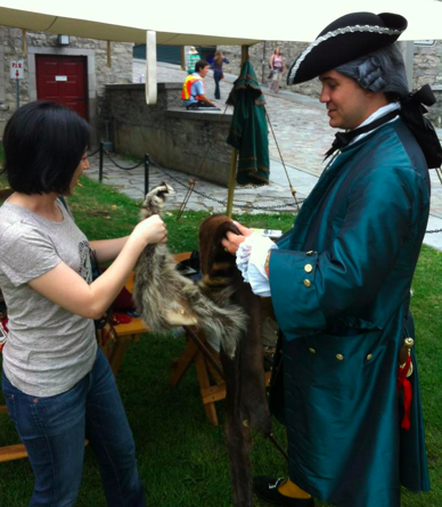
Outfitted in historic dress for the second quarter of the eighteenth century, I engaged visitors on topics as diverse as the fur trade, costume in New France, the colonial social hierarchy, and even furniture (I have yet to master anything close to a Québecois accent or vocabulary in my spoken French, so people eventually asked where I was from and what I was doing in Québec, which was a perfect segue to mention my thesis research). With August representing a peak in tourism, the festival crowd is incredibly diverse. I was switching between French and English the entire time as Americans, Anglophone Canadians, French, Francophone Canadians, and others of all ages and nationalities stopped in to ask questions and inspect the reproduction objects, furs, and maps. Many had little to no background in the history of French North America and had thoughtful things to contribute through their questions and comments.

Picture
Identifying furs
I've always enjoyed living history animations because of how they allow the visitor to personally engage with the past in a sensory and tactile way. My first museum experience involved working in costume on a recreated 1771 tenant farm in middle and high school. Working as an interpreter at Colonial Williamsburg and taking public history courses as an undergraduate solidified my opinion on the effectiveness of this type of interpretation and inspired me to continue on my own through volunteering at historic sites and trying my hand at making my own historic garments. It's a simple and fun way to relate to the people of the past as human beings rather than flat, one-dimensional characters out of a textbook.

At the New France Festival, the public was actively engaged and asking me great questions. Several guests stayed and chatted for over half an hour. This kind of personal exchange was completely natural and, unlike in a classroom setting, neither forced nor subject to scrutiny by a teacher or the rest of the class. I could tell that visitors were at ease, and although it sounds cliché, I could see their eyes light up upon seeing and handling a reproduction object or asking about my clothing. It definitely clicked for them, and was the perfect end to my trip to New France!

*Merci à Joseph Gagné pour les photos !
Picture
She found Québec!
Picture
More fur ID
Picture
Picture
2 Comments

Research Trip Highlights

8/9/2013

4 Comments

 
Being "in the field" has kept me super busy, but things have been great. This a quick post with a few pictures and descriptions of where I've been and what I've been doing
Picture
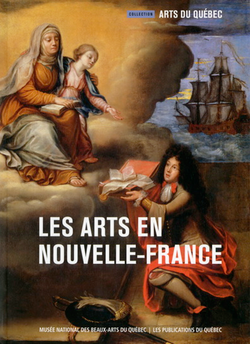
The very first thing that I did upon arriving in Québec City was a trip to the Musée national des beaux-arts du Québec for the exhibition Les arts en Nouvelle-France (the arts in New France). This is the first major exhibition on the subject in decades and included objects from nearly every genre and medium present during the period. Furniture, paintings, silver, sculpture, printed media, and ceramics formed the crux of the show.

Picture
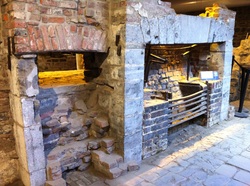
I had the chance to meet with Parks Canada staff for a private tour of the archaeological site of the forts and château-Saint Louis! Archaeologist Pierre Cloutier, Curator Claire Desmeules, and Historian Brigitte Violette went out of their way to offer me a private tour of the site, hidden under the boardwalk of the Terrasse Dufferin. It was great to talk about my research with the staff and exchange ideas, all while learning more about the site with the experts.

Picture
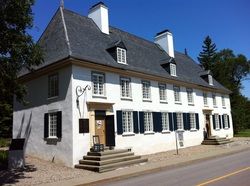
The manoir Mauvide-Genest was built in two parts on the Ile d'Orléans, a large island in the middle of the Saint Lawrence River. Now open to the public, I met with the director to talk more about the collections and furnishing plan. The manoir is one of the few surviving French colonial structures in Canada, and I felt that it was important to include it in my research itinerary. A symbol of the seigneurial system and the semi-feudal nature of French colonial Canada, it was the heart of a large estate that included roughly the western half of the island. The manor was built by Jean Mauvide, a French-born surgeon from Tours, who continued to practice medicine and directed mill and shipbuilding businesses from the house. 

Picture
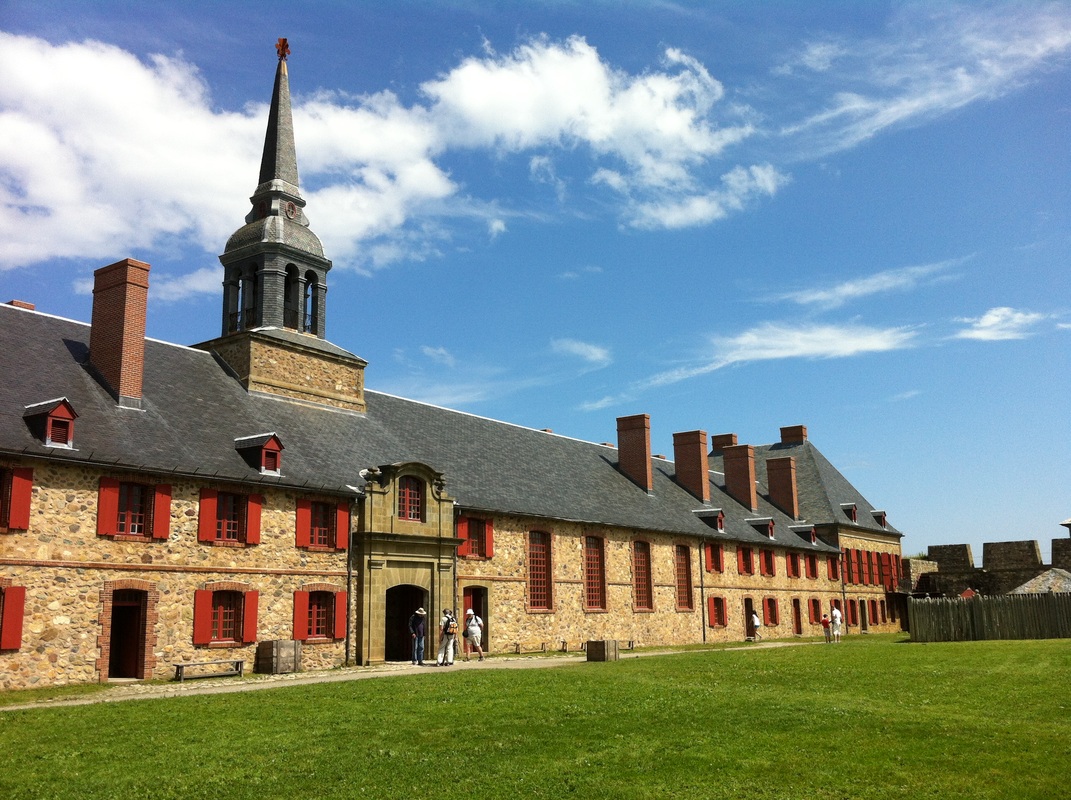
Louisbourg deserves its own post...it was fantastic. The reconstructed fortress sits on the coast of Cape Breton Island in Nova Scotia and interprets the year 1744. By 1750, Louisbourg was the fourth largest settlement in North America and an important French power base. Taken by the British in 1745, it was returned to France after the end of the War of the Austrian Succession in 1748, then taken again by Britain in 1758 during the Seven Years' War. Rather than risk having to give it back to France a second time, the British bombarded it, leaving nothing but ruins that were rebuilt in the 1960s. The Fortress of Louisbourg is the largest historic reconstruction effort in North America. Its most imposing reconstructed building is the king's bastion, where the governor, military officials, soldiers, and domestic staff were lodged. With historian Anne Marie Lane Jonah and curator Ruby Fougère, I toured the governor's apartments and got a preview of an upcoming exhibition on furnishing Louisbourg and the importance of probate inventories.

Picture
Picture
Trois-Rivières was founded in 1634 and represents the second permanent settlement in New France. The third largest community in the colony after Québec and Montréal, Trois-Rivières offers a number of historic sites that date to the French regime, including the manoir Boucher de Niverville. Begun in 1668 and enlarged in 1729, the manor is restored and offers a thematic exhibition on the colonial bourgeoisie. Site administrator Julie Desaulniers showed me through the exhibition, and generously took the afternoon to show me around the historic area of Trois-Rivières. Super fun!

4 Comments

    Archives

    February 2016
    January 2016
    December 2015
    September 2015
    July 2015
    June 2015
    May 2015
    January 2015
    May 2014
    April 2014
    February 2014
    January 2014
    October 2013
    September 2013
    August 2013
    July 2013
    June 2013

    Àbout:

    A graduate student with an interest in the people of the past and their things

    Catégories

    All

    RSS Feed

Powered by Create your own unique website with customizable templates.